Something different today! By request, I’ve documented my 3D modeling process with a sped-up screen capture. (You’re welcome, Pete!) Watch me work on the area that corresponds to the transepts of Durham Cathedral, as well as the Prisoner of Azkaban version of the central tower. I’ve tried to keep the commentary relevant no matter whether you’re a fellow Blender user or not.
If you’re interested in more videos like this, comment here or on the video to let me know! They take some extra work but I can do more if there’s enough demand. Don’t forget to subscribe to the YouTube channel too!
Here are a few renders of the progress seen in the video. As always, click for larger versions:
After finishing the video, I put the last few touches on the central tower:
I ended my last post on a positive note. Sadly, my enthusiasm was perhaps premature. As soon as I started adding windows to the viaduct entrance, I ran into the sorts of issues with dimensions and proportions that so often plague projects like this, at least when you don’t have complete technical drawings at your disposal. The top of window X is supposed to be even with the top of window Y, which is about a third as tall as window X, but if I move window X to be even with window Y, it’s no longer in the right place relative to feature Z…that sort of thing. Really frustrating.
Fortunately, I’m not as much of a perfectionist as I used to be, so I pressed onward, accepting the fact that close comparisons with the original Hogwarts miniature would still reveal small discrepancies. The overall dimensions are still very accurate – welllllllll beyond the accuracy needed for a casual viewer to be able to say, “Hey, that’s Hogwarts!” And thanks to the photogrammetry I’ve been able to pull from various videos of the castle, I shouldn’t end up with any errors that snowball into large-scale catastrophes. (Famous last words?)
The windows look funny without nothing but sky and water on the other side, but that will be resolved when I enclose the other sides of the building. For now, the south facade at least is complete.
I next turned my attention to the thinner towers directly behind the ones you see here. Like the towers in front, these had their spires completely revised in Order of the Phoenix, but I’m still working on the Prisoner of Azkaban version for now. There’s still a long way to go with the Durham area of the castle, but this is already starting to really change the look of the front of Hogwarts:
One of my favorite details on these less prominent towers looks like something out of the Winchester Mystery House: a door that opens from the battered base of the tower into midair, with no balcony or stairs or anything, a good couple of stories above the ground. Take a look toward the bottom of the tower:
No idea why they included this door – nor whether it’s also present on the identical tower on the other side, though the extremely minimal photographic coverage of that area seems to suggest that it’s not. (I also know the door disappeared in the digital DH/FB version of the castle.) In any case, my model omits the door on the other tower and attempts to include as much detail on the neighboring walls as can be divined from the available reference. Those constitute one of the most hidden areas of the castle, so if you miraculously find any overhead shots that peer into it, please comment!
The beginnings of the central tower are visible right below the camera. You can also see that I’m starting to get cautious with my symmetry. While the footprint of this part of the castle was indeed symmetrical in the original Sorcerer’s Stone design, changes to the adjacent areas in the third film necessitated shortening the area on the right that corresponds to Durham’s south transept. Below I’ve given us X-ray vision so we can get an impossible angle. Take a look at the walls on the right with the three windows – those are the ones that got shortened on the opposite side.
As we get to the transepts, the similarities between the Hogwarts miniature and the real-world Durham Cathedral become more and more evident. There are still discrepancies, though; I’m favoring the VFX miniature’s design in those areas, especially since this part of the actual cathedral isn’t even seen in the films.
I’ll round out today’s post with some untextured orthographic views of the entire Prisoner of Azkaban model as of this moment. Coming along!
P.S. If you haven’t subscribed to my new YouTube channel, I’d recommend it. I don’t have much content up there yet, mainly because the project is still very much a work in progress, but especially when we start getting into the final stages, I’d imagine I’ll be posting a lot of videos. I did recently post the raw visual effects shot of Hogwarts I created for the teaser for Les Fondateurs 2: La Quête de Gryffondor (The Founders 2: Gryffindor’s Quest).
With the SS/COS grand staircase side project complete, let’s hop back over to the main model!
The basic layout of Hogwarts in all the films is divided into two halves – a wing to the south where you have things like the Great Hall and the marble staircase tower and Gryffindor Tower, and a north wing that’s largely based off of real-world architecture at Durham Cathedral and Alnwick Castle. There are three footpaths that connect these halves:
The viaduct, which is by far the most noticeable, as it’s the largest and it’s situated right out front. This one goes all the way back to Stuart Craig’s early concept designs, and it stayed virtually unchanged all the way till Deathly Hallows, when it was enlarged and reoriented to become the main route into the school. (A new stairway was added so that there were still three paths connecting the halves of the castle.)
The stone bridge, which is much shorter and rather higher up than the viaduct, but still quite visible. It also dates back to the early concept art.
The suspension bridge, which isn’t seen particularly often but remained more or less unchanged throughout the films; it just moved around a little.
Each of these was in a different state in my model: the viaduct didn’t exist at all, the stone bridge was complete, and the suspension bridge existed as an early attempt that I hid sometime last year. I decided to hold off on that till later, but I did need to get the viaduct in place so I could start work on the north wing!
There’s a lot of good reference out there, so the viaduct wasn’t particularly difficult:
You may notice I’ve begun adding some subtle atmospheric perspective or mist to some of these renders…it can really help provide some depth and separation, particularly since the entire castle is pretty homogeneous in terms of color and texture. That’s becoming more important as the castle continues to sprawl further and further out.
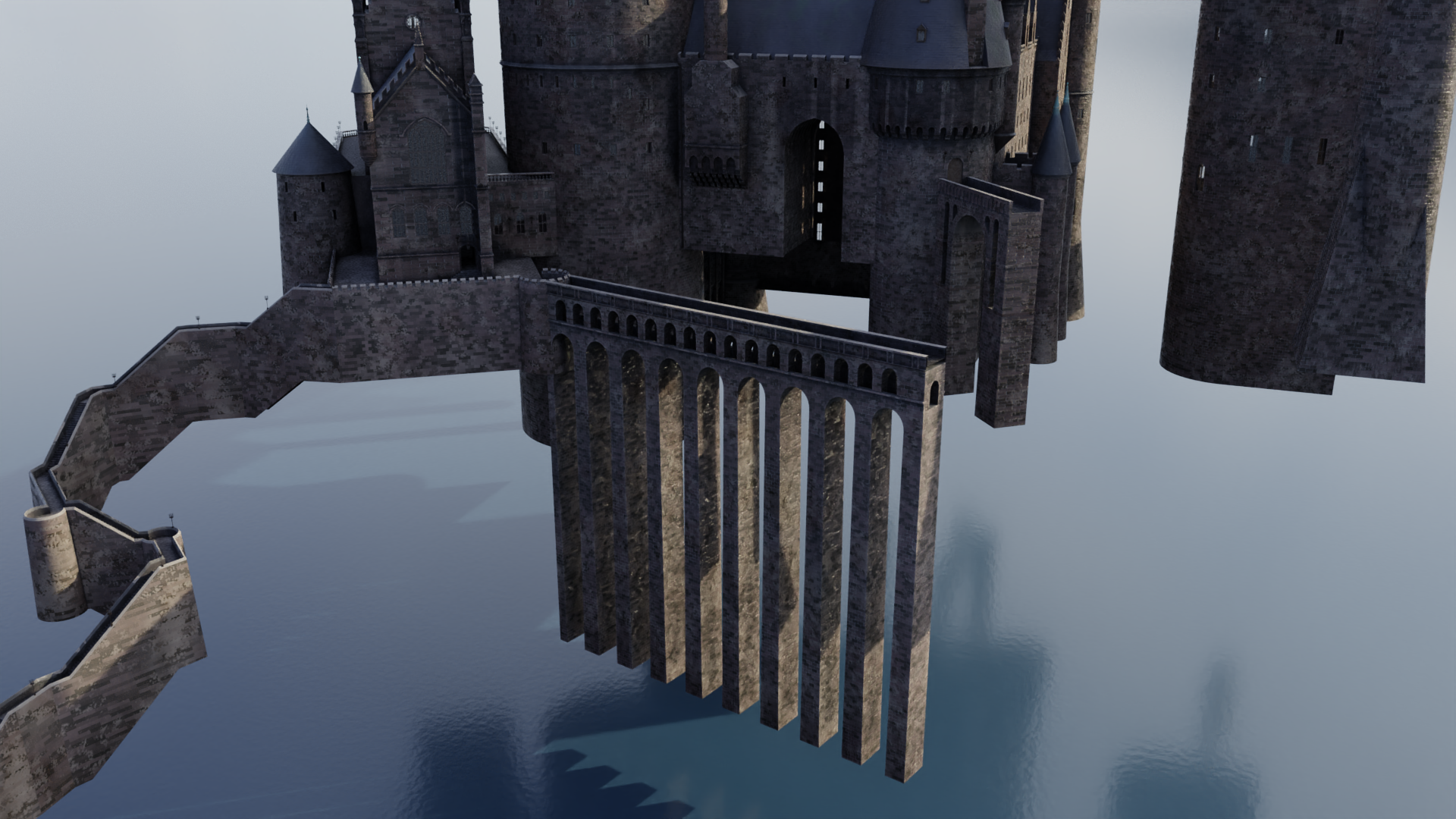
Anyway, with the viaduct completed, I turned my sights to the so-called viaduct entrance – as in, the entrance to the north wing from the viaduct, not the entrance to the viaduct. It’s framed by two towers that remained largely unchanged throughout the films; their spires just got a little steeper in Order of the Phoenix. They also added a window to Snape’s dungeon at the base of the one to the left, but that’s hidden from a lot of angles…and since I’m working on the Azkaban version of the castle right now, I don’t have to worry about that yet anyway.
I began adding the left tower, as well as the semicircular area at the end of the viaduct. This is also a nice silhouette of the stone bridge in the background:
Once the details started really coming together, including the shallower spires seen prior to OOTP, I mirrored the left tower to the right side as well. (The two are identical, other than the fact that one of the windows on the left tower is replaced by a door to the stone bridge.)
Here they are complete!
That smoke sim is paying dividends…I’m really digging in in this render.
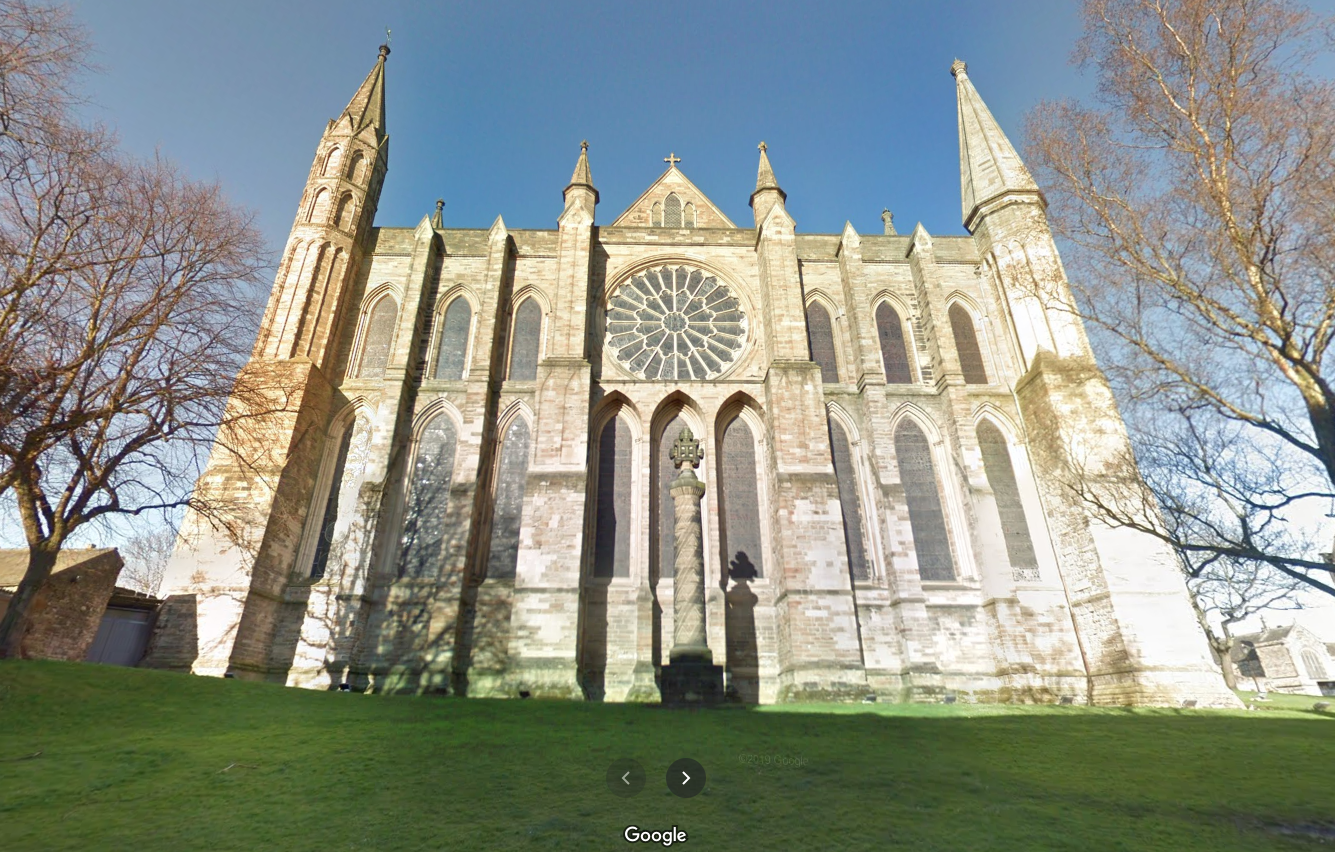
The wall that connects these two towers is interesting. It forms the southernmost face of the so-called long gallery, sometimes even just referred to as the Durham building because as I said, so much of its design is based off of Durham Cathedral. That cathedral was a real-world filming location for the first two films, and there are some areas of the miniature that follow its design pretty slavishly so as to meld well with the location shoots.
This south wall, though, corresponds to an area of Durham never seen in the film. This what it looks like in real life, courtesy Google Street View:
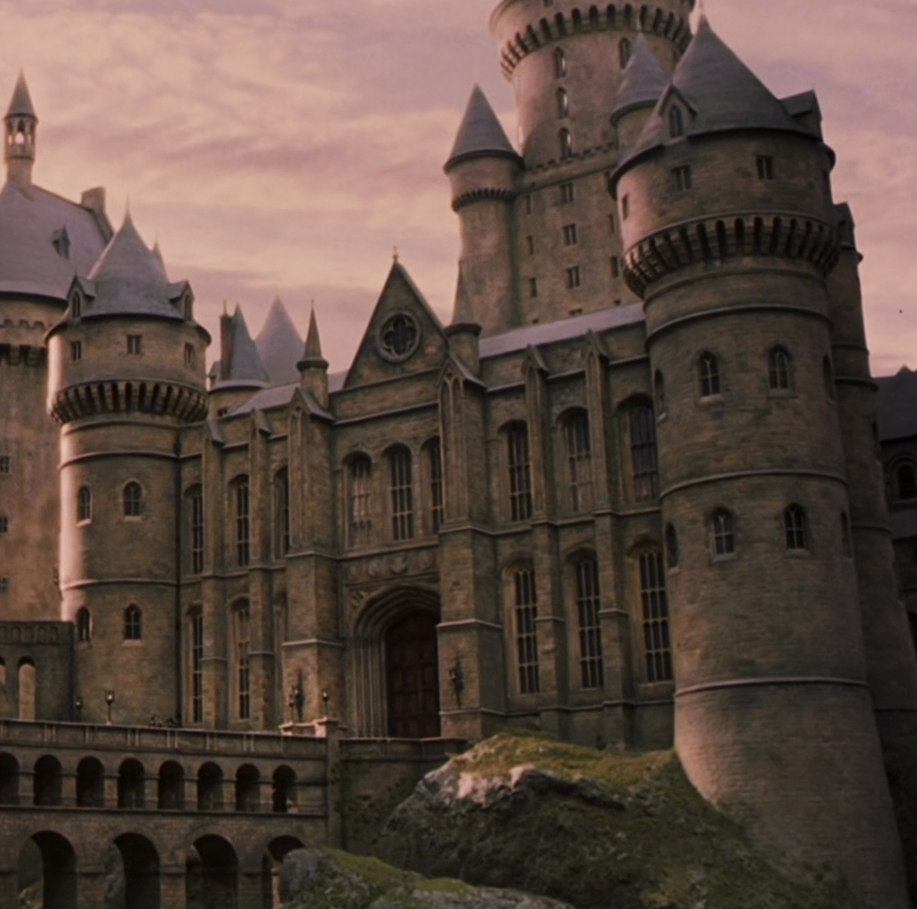
Since they never shot any scenes right here, there was freedom to modify the design for the visual effects miniature, which looks like this:
As you can see, the miniature retains the overall shape and dimensions, but many of the details have been changed. The large rose window is replaced with a much smaller and less “churchy” version, and front doors have been added – front doors that are identical to the doors to the Great Hall, which are in turn identical to real-world doors at Christ Church at Oxford. (The doors are, however, scaled up to about twice the size – nearly 30 feet tall in the imagined real-world scale the miniature represents!) The windows are very Oxfordesque as well.
Anyway, I began adding this south wall:
I didn’t have to create those huge Oxford doors completely from scratch this time…the archways in the grand staircase side project are variations thereof, so I was able to bring one of those archways into this file and modify it appropriately. (I admit it’s kind of a hodgepodge of super-precise areas and others that are merely close to correct…ssshhh, don’t tell anyone.)
I then added the four house crests – plus the main Hogwarts crest – above the door, using bump maps to simulate the relief. Here’s a student’s-eye view from the viaduct:
It’s especially nice now that I remembered to make the windows visible! Ignore the light under the doors though.
I don’t know why I was psyching myself out prior to starting the viaduct entrance…I had this weird gut feeling that it wasn’t going to look right, or I wouldn’t be able to get the dimensions to all agree with each other, or something…but I really like the way this is turning out! Stay tuned for more updates as I add windows, the triangular area with the small rose window, and the two small spires on either side!
Haha! It’s finished – the version of the grand staircase from the first two Potter films! Join me for a complete video tour!
To get us to this state of completion, I had to add the remaining doorways on the landings:
Then came the big window at the back. Much of the molding is taken directly from that Oxford design I created in the last post. The scene beyond the window is a bit of a cheat…I just did a nighttime render of part of the main castle model, blurred it, and dropped it in like a scenic backdrop in a real set or miniature. It’s not perfect but it gets the job done.
With these elements in place, the only thing remaining was the paintings…but I decided they’d be too much work, I’m omitting them, at least for the time being. They don’t have anything to do with my main purpose (understanding the geometry of the stairs) or my secondary purpose (examining the scale of the space).
Speaking of which, here’s the long-awaited scale comparison between the castle exterior and the grand staircase interior!
They kinda almost fit together at the intended in-universe scale! Of course, if you include all the digital extensions at the top or the extra miniature passes used to extend the bottom, that all goes out the (beautifully mullioned) window. But I think that’s kinda okay.
This concludes my work on this side project…it’s been a fun one! Now back to the main castle model.
With the basic structure of the wooden bridge in place, I next set out to adjust the support beams below. The bridge spans a ravine and its cross beam patterns do vary. Paying close attention to their arrangement in the original miniature, I first modified the half closest to the castle:
Then it was just a matter of duplicating the structure to the far side and tweaking a spot where it’s not quite symmetrical:
This brings the bridge to a complete state…at least, without all the shaky imperfections that give the original its charm. Time to get those in there.
My weapon of choice was Blender’s Mesh Deform modifier, a nondestructive tool that allows you to manipulate one object’s shape and have it affect the shape of another. I created a much, much simpler version of the bridge – really just a 3D envelope to roughly surround it – and manually pushed different sections around to approximate the swaying structure seen in the films. Blender obligingly shifted the detailed model of the bridge to match.
Just for fun, here’s the simplified envelope visualized with a translucent material around the actual bridge model, prior to any distortion:
And when I warped that envelope (twice due to some annoying lost work), it made the detailed bridge underneath look this!
(This is after breaking apart the roof into some separate chunks with their own local coordinates so that the shingle texture would map correctly onto them.)
I’m feeling quite happy with this! It’ll look a lot better once I’ve added terrain, of course. And even just adding the gatehouse at the other end will help. I think that’ll be my next task.
Short post today. I finished the clock tower! The only two pieces I still needed to add were the big window in back and the enormous pendulum that hangs down through the entry. Both are now in place! (I’d avoided the window for ages because I couldn’t find a clear shot of the tracery. Then I randomly came across a shot of a window at King’s College Chapel and realized that it was the exact same design. Problem solved!)
Around the other side of the building, I’ve been really hesitant to finish the hospital wing because the placement of the detailing toward the bottom will depend on the detailing of the surrounding quad walls, and I haven’t been able to add those due to insufficient reference. But I bit the bullet and at least took care of the top section:
I’ll still need to add the windows and so forth down below once I’m able to complete the quad. In the meantime, I’m gearing up to probably tackle the (gulp!) wooden bridge next.
Let’s return to my efforts with the separate model of the grand staircase from the first two films, as described in this post. With mockups and tests out of the way, it’s time for a real attempt at modeling the grand staircase! All of the flights of stairs in that room (other than a few at the bottom) have identical designs and dimensions, so I’ll be able to do a lot of duplication here. We’ll start off simple:
Cool. Next comes the room itself, or at least a very basic start at representing its shape. Starting to duplicate some elements, throwing in some basic lighting and coloration…
Yeah, this is gonna work. I decided from the get-go that I wanted this side project to be geared toward Blender’s Eevee render engine, rather than the slower but more realistic Cycles engine I normally use. Makes it a lot quicker to churn out renders as I go.
I started messing with the animation early on. This adds a whole different level of complexity to the project, since the motion of the stairs also affects the configurations of the handrails…and typically when one flight moves, another has to move to get out of its way…but the flights can’t all move simultaneously without colliding into each other…yeah, it’s tricky. Still, I was able to get the first few flights working with fairly minimal “cheating” – here are two views with all the swiveling stairs (so far) in their two main positions.
To help you get oriented, the long landing at the bottom right (with the baluster shadows on it) is where Harry and friends first emerge into this room. I just haven’t built the archway through which they enter, or the rest of the set beyond. The first render reflects the way the model was built; the second reflects the alternate positions after the stairs have rotated.
One thing that helps with this is that I’ve activated backface culling for the room itself. In computer graphics, each surface “faces” a particular direction; we call this the normal. Ordinarily you can see the surface from either side, but with backface culling, you can only see it from its “front” side. I built the room so its normals all point inward, which means you can always see into the room, no matter what angle you’re at.
I paused work on the staircase to switch back to some of the other stuff I’ve more recently posted about, and that’s when I hit a snag…another fan turned me on to some old issues of Cinefex magazine that describe “an eighth-scale, forty-foot miniature, laid on its side to aid construction and photography” (#88, regarding the first film) and “a 40-foot-long staircase miniature built previously” and reassembled as it was before (#93, regarding the second film).
This stumped me. Hard. The model was indeed laid on its side, but at 1:8 scale, the various real-world items strewn about in construction photos would look much, much larger than they do. And if the miniature still measured 40 feet along its longest side at 1:8 scale, that would make the “real thing” 320 feet tall…and by my calculations, it should only be in the low 200s.
Ultimately, I’ve decided to press forward with my original dimensions, essentially disregarding the Cinefex figures. My best hypothesis is that the reference to 1:8 scale is incorrect – probably a misreading or misremembering of 1:3 scale – and the 40-foot figure isn’t the distance from the room’s bottom to top, but from the open wall nearest the Great Hall to the opposite wall with the large window. That math actually works perfectly if the scale was indeed 1:3.
So I continued building the rest of the flights of stairs. It turns out a little more “cheating” is necessary than I originally hoped…some of the balustrades are going to have to magically pop out of nowhere. But then again, the castle is magical. And the only alternatives are to leave unprotected ledges 200 feet up (yikes) or to have some of the balustrades sweep right through the landings, knocking off any students in their way (yikes again).
In any case, I’m mainly focused on the configuration in which the model was built; all the stair movement was digital (other than the one full-sized flight on the set that actually moved). The movement is just a bonus. With all the flights in place, it looks something like this:
The walls, floor, and ceiling are still just placeholders, really, and I haven’t added the lamps below the landings yet. But the stairs themselves are all accurate! Notice how they form two unconnected spirals that switch sides at the top and bottom. In a future post, we’ll add more detail to the rest of the room, and maybe some less generic materials. Then come animations and flythrough/around videos!
More staircase stuff to come, but for now, back to the main project! With my clock tower photogrammetry in place, I was able to finish up the clock tower’s entryway, again relying more on shots of the set than shots of the miniature, since that area is really only visible from above or from within the courtyard. Fortunately, the sets seem to match the miniature pretty well here. Even though the miniature as currently installed at Leavesden has the doors closed and portcullis down, I decided to keep mine nice and open. My Hogwarts is a welcoming, friendly place. Just look at all the people.
Awkward. Well, anyway, the details look cool, but it’s hard to see beyond the archway; it gets darker in the shadows. Let’s crank up the exposure a little and move beneath the arch to take in all this stuff that we’ll rarely see otherwise!
The actual interior is still dark and boring, but there’ll soon be big windows on the other side of the room.
Let’s talk about those doors, by the way. John Williams wrote a cue for the scene in which they’re locked to secure the school, and he called it “The Big Doors”. He wasn’t kidding. They’re HUGE – around 67 or 68 feet tall, by my estimation. I’m sure they only built the bottom portion for the set, but in the miniature, they just go up and up and up. Imagine the weight…imagine trying to open or close them by hand…
Anyway, the next step was to add windows on the other faces of the clock tower, as well as the details on the dormers along the roof. (Fortunately, these seem to be very similar or identical to the ones on the roof of the Defense Against the Dark Arts building, which I’ve already created, so this didn’t take long.)
With those finished, there are precisely three details left to add to the clock tower: the big window in the back, a small arch at one of the corners, and another door at another corner. Oh, and probably the clock pendulum, too. So four. But I can’t find good reference for the big window, and there’s no point in putting in the pendulum till I have the big window to silhouette it against…and the placement of the arch and door will depend on the placement of the courtyard, and I’m not going to build the courtyard till I’ve built the ruined fountain in the middle. (No sense in enclosing the courtyard and then having to constantly hide pieces to build the stuff inside.) So the fountain is up next!
All right…the main model is still going strong, but I’ve found myself intrigued by a side project: the grand staircase, AKA marble staircase. Much like a parking garage, its interwoven spiraling structures are hard for my brain to visualize, which makes them fascinating to reconstruct.
I’ve specifically focused on the version seen in the first two films…after that, it went through some changes, though those changes remained subtle until Deathly Hallows. But in the first two films, it seems to have been brought to life with the same miniature and full-sized partial set – with digital augmentation. (Incidentally, based off of the few images of the miniature I’ve found, I’m pretty sure it was built on its side at somewhere around 1:3 scale…but don’t quote me on that. If I’m right, that would make the miniature over 50 feet long.) [EDIT: I’ve now found a source that claims it was a 40-foot miniature built at 1:8 scale, which doesn’t seem to work mathematically. I’m not sure what to make of this.]
Initially, my primary goal was to replicate the set. I figured the miniature was kind of its own thing, and I got to work aligning technical drawings and photogrammetry and so forth just for the set. (Each of those small orange shapes is where the camera was for a specific frame from the film…pretty cool to see how the camera moved through the space!)
After more closely studying both films, I came to realize that the available reference material does consistently and explicitly establish the spatial relationships between the set and the miniature. (Thank goodness the different paintings and frames provide excellent reference points!) So I changed tack: the new goal was to create a single model that brought the set, the miniature, and the digital elements together. This was aided by a bit of photogrammetry from Chamber of Secrets that worked WAY better than I thought it would:
So the good news is that I had a lot of information to work with. The bad news is…it was a lot of information! This room is enormous and very repetitive, so it’s easy to get lost in the reference images and forget which staircase is which. I tried to just jump right in with the modeling, but confusion set in pretty fast, so I decided this would just be an exploratory first pass. I kept this mockup simple and not super precise. Still, I kept getting lost, so I spent a long while color coding flights of stairs in both the model and in my reference images. Here’s a glimpse of just part of that process:
It looks like a gaudy mess, but for the first time in my life, I understood the complex geometry of the grand staircase! Things I learned:
In plan view, the stairs form three adjacent squares. The flights that actually move are all part of the middle square.
There were definitely at least 36 flights in the miniature – more likely 38, but I can’t find a clear angle confirming the last 2. Regardless, these cover 19 different levels, each 10 feet high. Almost every levels has 2 landings on opposite walls of the room. (I’m hesitant to call these floors, since Hogwarts isn’t really supposed to have 19 of those…but each landing does have a door…)
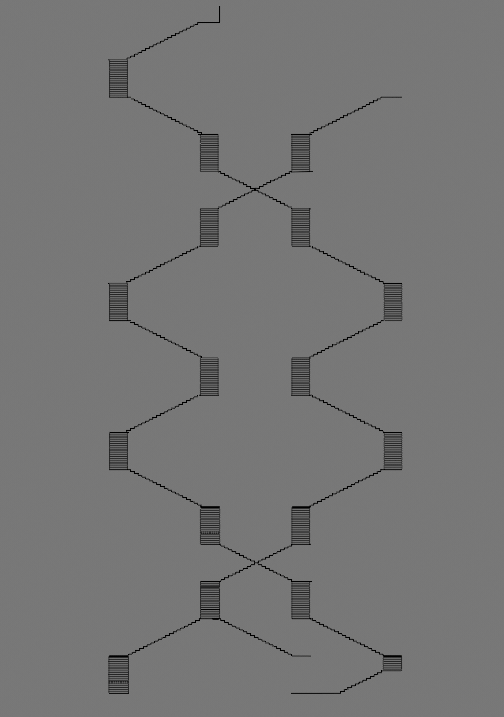
In the miniature’s “default configuration”, so to speak, the flights are organized into two separate helical pathways. In the middle floors, these each spiral in a clockwise direction as they ascend on opposite sides of the room. Toward the top and bottom, the two pathways intertwine so they can switch sides. Through most of the model, the two paths are identical; they’re just rotated 180 degrees relative to each other.
The bottom-most level is a bit irregular and doesn’t follow rule #3.
If all the flights that form part of the middle square rotate 90 degrees from their bases, you end up with more of a DNA-like double helix, as opposed to two side-by-side helices.
In the first film, we look all the way up and the stairs seem to continue into infinity. The most distant stairs were added digitally to obscure the top of the miniature. These aren’t part of my model.
In the second film, the camera moves swiftly downward through the miniature; the set is composited in toward the bottom. Below the set are still more stairs; these were created by shooting the miniature again from a different angle and compositing it in as the bottom.
Clear as mud, right? Yeah, it’s hard to visualize. But the rough mockup was a success in that it gave me a clear roadmap for making a serious attempt at modeling the grand staircase. I’ve already begun, and I’m looking forward to sharing the details in a future post! In the meantime, here’s an orthogonal elevation-style view of the mockup, just for fun.
Ugh. I’ve indeed proceeded to the boathouse steps, and it turns out that they’re evil.
It all started out innocently enough. There are super detailed drawings available for the Deathly Hallows version, so I started there. I figured I’d work backward to the GOF/OOTP/HBP version, and then finally to the SS/COS/POA version. Above is the DH version in the process of being built, along with a newly wavy lake surface. Below is what they looked like when I was done:
Okay, so far, so good. It looks weird, but that’s just because they’re untextured, they don’t have any walls, and they don’t match up with the POA castle around it. The technical drawings were very explicit and internally consistent, so I felt very confident in this setup. Next up: the version from the middle three films! Should be easy, right? Just follow the floor plans, and then adjust the height to match the exact vertical distance between the boathouse floor and the viaduct courtyard floor, right?
Wrong.
It all went askew when I compared my steps to this angle of the HBP model at Warner Bros*:
See how the steps come right up to the bottom of the boathouse roof? Yeah…mine didn’t do that. They stopped noticeably lower. Something was off with the vertical scale. Presumably, some of the flights were supposed to be steeper than others. But it also occurred to me that my vertical measurements for the boathouse weren’t particularly precise either, so it was risky to try to get these disparate approximations to match up with each other.
No problem! Fortunately, this version of the castle has better photographic documentation than any other, since it’s open to the camera-wielding public. I was particularly enthused when I found this video – I knew Meshroom would like the camera motion, coverage, and image quality. So I fed a bunch of frames into the photogrammetry software and let it run. Actually, I let it run multiple times on different subsets of images – running everything all together resulted in some errors. Then I plopped all the different scans together into the same physical space:
Not exactly pretty, because this is a half-dozen scans with different lighting poking through each other haphazardly due to the limited precision of this method – plus lots of junk data floating around. (A lot of the stuff up top is the lighting fixtures from the Warner Bros. Studio Tour, haha.) Still, I figured this should provide some good reference, right?
Well…it turns out that the floor plans don’t quite match up with any of the scans. So that’s annoying. Again, it’s probably the result of the limited precision of this photogrammetry, but it makes it tough to trust this information.
And that’s really where I’m at right now…still trying to figure out the boathouse steps. I may end up needing to adjust the boathouse’s vertical scale, too. Oy…wish me luck.
* Apologies to the photographer for not giving credit. I’ve somehow lost wherever I found that image. If you recognize it as yours, please don’t hesitate to let me know!








 Hogwarts 4D